Saturday, September 24, 2011

Corzetti Pasta


Elyssa loves to cook and is outfitting her new kitchen with great cookware and utensils. I went along with her to pick out pots and pans at a kitchen store she heard about from a chef friend. I was forewarned: when you first walk into the store you're underwhelmed; it looks like many other run of the mill casalinghe (kitchen supply stores). Even after browsing a bit I still wasn't impressed, but the more we looked around the more I realized that this store was very well supplied with just about everything, including a vast assortment of the best cookware on the market. More on this later as the store merits its own blog post.
Owner Simonetta is a fountain of in-depth knowledge on every product this kitchen store sells. I recognized her immediately and we soon realized we knew each other from the Gambero Rosso three years ago when we were both professionally active with the company. In between selecting everything Elyssa needed I also picked up a few great things. I love making unusual pasta shapes and forms and am always on the lookout for new items. Simonetta sold me a tool to make corzetti, a disk shaped pasta with a giglio fiorentino design. So this morning the first thing I did was to make corzetti for lunch.


After making a smooth and elastic sfoglia by kneading the dough for a good five to ten minutes and then rolling it out thinly, I cut out as many small disks as possible. I then used the stamp to imprint each disk with the giglio fiorentino design.


I used some of the last cherry tomatoes from our garden to make a simple tomato sauce with olive oil and basil. Although this isn't the traditional sauce used for corzetti, a pasta originating from the Liguria region in northern Italy, it was a perfect marriage with the pasta. In Liguria pesto is the traditional sauce used with corzetti.
Corzetti don't always have a giglio fiorentino design; in Liguria one stamp features a coat of arms with a rampant lion. In addition to its decorative function the design also helps the sauce adhere to the pasta.
The Encyclopedia of Pasta, by Oretta Zanini de Vita and masterfully translated in to English by Maureen B. Fant, dedicates a two page description to corzetti, along with drawings of the corzetti and the corzetti-making tool.

Sunday, September 11, 2011

Reflections on the Ten Year Anniversary of 9/11


I got up very early this morning to head into Rome for a 9 am memorial mass commemorating the ten year anniversary of 9/11. The sentiment ten years later is quite different from what it was ten years ago: anger, bitterness, disbelief, and the most ignoble of emotions: hatred.

The world is wiser now, at least I hope so, and focused on peace. The mood is reflective, looking to a future of optimism and global camaraderie. No one will forget, as the above pictoral tribute on the cover of a Romanian newspaper shows.

As I drove into Rome it was hard to believe what happened a decade ago, especially on the crisp, crystal clear, blue-skyed day that this September 11th is. I picked up the Sunday paper and was moved to see the entire front page of the Italian Corriere della Sera covered with a moving, water color memorial to 9/11:


After the memorial mass I received a message from Karen, now in the United States, with her reflections on what she was doing at the moment the attack on the Twin Towers took place. Karen is a poignant writer and I've shared her messages before, as I do now:

"a memory if you feel like reading something

I was teaching English to a small group of Saudi students in a pre-paramedic program in the fall of 2001. There was also one Japanese student who had joined the class to brush up his English skills. On September 11, my students were taking a practice
English test - the big test that foreign students must take to study at most universities and colleges in the US. We had finished the listening section, and they started the rest of the test, the grammar and reading parts.

I got up to get a drink of water for myself, and walked by the program director's office - he had his radio on, and the paramedic teachers were standing there, looking grave. "A plane hit one of the World Trade Center towers," one said. How awful, what a terrible accident, I thought. I used to work on Wall Street, I used to take the subway home from the WTC station...I got my drink and then headed back to my classroom, and, as my hand went to the door knob, one of the paramedic teachers came running after me..."A second plane hit the other tower." We looked into each others' eyes in silence. No more needed to be said, we knew then that it was a deliberate attack.

I went to call my husband back in our house 30 miles away. He was killing time before taking a job with a Japanese government agency, the "househusband" that year....I knew he would not be listening to the radio, and we had no TV. He was silent with shock and then he half-whispered, "Don't let it be Japanese who did this, please don't let them be Japanese." I told him to stay in the house in case the kids were sent home, and to stay off the phone in case the school called the parents.

I went into the classroom and sat down, watching my students intensely reading, frowning as they searched for answers. I sat and waited for an hour and a half more, as they worked wordlessly on the test, coloring in the little circles indicating answer a or bor c.... I got up every 15 minutes or so to follow the events on the radio in the paramedic director's office, returning to look at those young men. But they were boys, really.

The Pentagon was hit.

I was old enough to be their mom. One of them had told me I was a year older than his grandmother! (I was 45 then.) Just boys. What time was it in Saudi Arabia, I wondered. Did their mothers know about the attacks? Word came of the US airspace and borders being closed. My students were now stranded in a foreign land; I watched them bite their lips, chew their pencils while thinking; their brows crinkled with the effort of concentrating on verbs and tenses and nuances of words and expressions. How many of my countrymen would see my Arab students as the enemy, would identify them with the attackers....in the office, the paramedic instructors' faces were ashen with intimate knowledge of wounds and death and grief, of broken buildings and broken bodies. They knew those kinds of wounds, those kinds of deaths. They knew firsthand the courageous fear of the firefighters who entered the towers when all others were leaving.

I went back into the classroom. It was quite, every now and then a student would sigh...erasers rubbed out answers... The Japanese student was here at the college alone, there were no other Japanese students that I knew of. Were there even any Japanese in this town? Who would he be able to turn to in his native tongue, who could truly understand his reaction, who could read his face properly? How would his parents feel knowing he could not leave the US to get to the safety of their home?

The fourth plane was missing.

The students finished the test. I couldn't face it, couldn't tell them at that moment. I wanted to hold that innocence for as long as I could..."Let's go over the answers right away," I said. "Let's not take a break now - we can take a longer one later..." We sat in a small, intimate circle, going over the answers. They added up the the scores of each section, compared the numbers with each other, talked about the hard and the easy questions, as if it were a normal class day. I was desperately holding on to normality as long as I could, keeping the events and confusion outside as long as possible. Was I wrong? Was I selfish? I don't know.

But I do know that I have held those faces, which stayed unmarked, unworried, unknowing for more than two hours longer than anyone else's I knew, held them in my mind for 10 years. I watched them intently as they discussed the answers, shared little jokes, complained about questions, watched them to remember their innocence as I kept them ignorant of the events which had occurred a few hours' drive away. And for 10 years I have held in my mind those faces when I had to finally tell them, in as simple and direct English as I could, what had transpired outside the door the small sanctuary of our classroom.

There was silence. I waited a few minutes, and I calmly rephrased everything - we ESL teachers are skilled in that, repeating ideas and facts in different words and phrases. They asked a few questions then; I quietly answered. They sat in silience again, and I said, "I think you should go to the internet and find the news in your own language." They bolted for the computer room down the hall, and I sat, alone, in my classroom which could no longer be my personal refuge in what had become a terrifying world."

From Rome to Romania, to the United States and all over the globe we are united in our personal memories of what happened ten years ago, and joined in our shared optimism and quest for a better, stronger world of peace.

Saturday, August 6, 2011

Pasticceria Mondi


At Pasticceria Mondi you'll find delicious mini-sandwiches; these are filled with sliced kiwi and brie, a refreshing change from your usual sandwich option....


I've been going to the Pasticceria Mondi regularly for about twenty years now. When Giulia was small it was the nearby morning coffee meeting point of choice among parents following school drop-off. Mondi also happens to be right around the corner from my favorite produce market at Ponte Milvio. My daughter is an adult now but I still head off to the market with cooking school clients several times weekly to pick up ingredients for classes. Mondi is a natural stop off point for a mid-morning coffee and sweet treat before we head off to start cooking. This week I took friends James Martin and Martha Bakerjian to Mondi, both travel & food writers, and I think they were both bowled over by the eye candy Mondi produces every day in its pasticceria.
Mondi is privately owned by the Mondi family who reside near Bevagna in Umbria. The pastry chefs who produce Mondi's edible works of art have mostly started off as young artisans within the pasticceria and made their career there.
Some of the most incredible things Mondi produces are their mini sanwiches (like tiny sliders) and bite-sized pastries, both so intricate and elaborate that when photographed it's hard to tell they are not full-sized, unless you hold one in your hand or place one next to a full-sized sandwich or pastry.

Mini sandwiches filled with tomato & shrimp, zucchini flowers & mozzarella and sun-dried tomatoes with a soft cheese & ground pistacchio nuts....


Bite-sized pastries filled with cream and topped with wild strawberries...


At the cash register you'll find a selection of mini gift pastries: miniature birthday cakes and seasonal items like Easter baskets and Christmas packages. Although these cakes are only several inches in diameter they are so elaborate that they look full sized.


It's not all about the mini pastries at Mondi. Some of the regular desserts are spectacular looking and beautifully crafted, and the temptation to purchase is nearly overwhelming.


Millefoglie presented in a refreshingly different way...


These caramelized nut baskets are filled with portion-sized desserts dipped in dark chocolate....


This cake, probably filled with some type of pistacchio cream, is covered in ground pistacchio nuts....


Mondi also prepares a whole line of candies; below is a variety of flavors and shapes of jellies...


Sunday, July 24, 2011

Scoop of the Week: Zucchini Ice Cream


I've been making a lot of ice cream recently and experimenting with different flavors. The best one I've made so far is zucchini ice cream. It's also the ice cream that everyone, across the board, loves. As long as I don't tell them it's made from zucchini. I really get a kick out of making a great ice cream from a vegetable.
The other thing I love about this ice cream is that it's another way to use up all the zucchini in my garden. Of course zucchini are not a weed, but they act like they are. Even if I miss a few days of gathering zucchini, when I finally make it into the garden I find I have enough zucchini gathered to feed everyone on my street. There are also inevitably a few "attack" zucchini in the garden: so large you can hardly lift them. I think they hide from me until they reach that size. Of course it's not true but it does seem so given how rapidly they grow. I find myself talking to the zucchini, asking them where they came from in such short time. Enough about that because already my daughter finds it odd that I personify the vegetables growing in my garden.
This is what I gather in my basket every day:


I explained my approach to ice cream in past posts: I'm trying to reproduce everything sweet that I love in ice cream form. In this case it's zucchini bread. I've looked at each of its ingredients, and selected those that make it uniquely zucchini bread. The zucchini are grated (better if it's everything but the very center of the vegetable where the seeds are).


The essential flavors that come through in zucchini bread are sugar and cinnamon, and sometimes walnuts. So that's what I used for the ice cream, to keep it simple yet delicious.

Ingredients:
  • Milk, whole - 1 1/4 cup (200 ml)
  • Cream - 1 1/2 cups (355 ml)
  • Vanilla extract - 1 tsp (5 ml)
  • Sugar - 1/2 cup (100 grams)
  • Cinnamon - 1 tsp
  • Salt - 1/4 tsp
  • Zucchini, grated (all except the seedy center) - 1 1/4 cup (190 grams)
  • Walnuts, finely chopped (optional) - 2/3 cup (50 grams)
Procedure:
  • Place all the ingredients (except the walnuts) in a saucepan and simmer until the zucchini is just tender but not mushy.
  • Place the pan in an ice water bath and cool completely.
  • Add the walnuts if desired.
  • Follow the manufacturer's instructions for your ice cream maker or:
  • Pour the mixture into a flat metal baking pan and freeze.
  • Once frozen the ice cream can be served, or stored for future use:
  • Transfer the ice cream into an airtight container and return to the freezer.

Wednesday, July 20, 2011

Topkapi - Turkish Restaurant in Rome


My friend Karen started the Lunch Bunch a few months ago to get friends together to try some of Rome's ethnic restaurants. Ethnic restaurants are not Rome's strong suit, but nonetheless it's nice to dine on something other than Italian fare, fabulous though it is.
Yesterday we had lunch at Topkapi (Via Nomentana 81, tel. 06 4429 2408, info@topkapi.it). Katie Parla briefly reviewed this restaurant back in 2010 when it was known as Antichi Sapori della Turchia. The Turkish Chef Hikmet Ozkaya was the chef at the Turkish Embassy in Rome prior to joining Topkapi.
The dolma (stuffed cabbage and grape leaves) were tasty:


I love Bakla Ezmesi (hummus made with fava beans) and although this dish photographed well it was disappointing. The flavor was bland, and as the dish had been plated hours before it was dried out.


By contrast, the fried calamari (Kalamar) was delicious. Chef Ozkaya's wife, who served us, convinced me to try it based on its Tarator sauce. The sauce was made with equal parts yogurt (homemade in the restaurant) and ground walnuts, chopped dill, garlic, cucumbers and salt. It sounded odd but the chef's wife was so convincing that I opted for it. When I tasted the sauce on its own I didn't like it at all.


The sauce with the calamari was fabulous; a case where the total is greater than the sum of its parts. The calamari were fresh, crisp, tender and cooked to perfection. This is the dish that will bring me back to Topkapi.


I also had a very tasty Barbunya pilaki: borlotti beans with garlic, carrot, tomato paste, olive oil and a touch of peperoncino.
We all shared a simple but tasty chicken and vegetable dish with a rice pilaf.


If you're curious about Turkish cuisine visit Wikipedia or Hayriye's Turksh Food and Recipes.

Sunday, July 10, 2011

"Tiella" from the Gulf of Gaeta, Southern Lazio


Sperlonga has been just about my favorite place on earth for well over twenty years. When Giulia was little we used to spend the month of June in a spartan, but charming beachfront apartment. Back then I was the only foreigner in Sperlonga, literally. Only the big hotels (and big still meant fairly small and family owned) had sdrai or lounge chairs, on the beach. No phone, no television and internet was unheard of. In a word, heaven. We bought all our food on a daily basis from local fish vendors, fruit & vegetable stands and a local alimentare, the same one I've been going to for twenty plus years.
On Friday my daughter and I, along with some visitors from London, decided to "escape" the heat by hopping a train down to Sperlonga. It was one of those hot, humid Italian days with no hint of a breeze. We rented sdrai and ombrelloni on the beach. These days there's not a square foot of beachfront area where you can throw down a towel and lay in the sand. In the end, I spent the entire day under the umbrella fantasizing about returning to the peace and quiet of my pool. But it was great fun all the same. The view of the hill town of Sperlonga alone made the excursion worth it. I never tire of that view. The water was clean and crisp and delightful: Sperlonga prides itself on having the top water cleanliness rating along the coast.
For me it always boils down to the food and Sperlonga offers plenty to satisfy. We kept it simple: a few gelati from the Pasticceria Fiorelli which, in addition to amazing ice cream, has the best doughnuts in Italy.
Then it was on to the same alimentare we've been going to for decades, still owned by Carmina and Sandro, still with the same ebullient sales girls working the banco gastronomico (deli counter). They are not girls, or even young women; they can't be if I've known them almost a quarter of a century. But they look it. They're so friendly and welcoming that I usually end up purchasing much more than I intended to.
We always buy plenty of mozzarella di bufala, made just hours before: warm and succulent and redolent of fresh buffalo milk. Our London guests ate theirs as soon as we left the shop, right out of the bag and dripping with milky flavor.
Carmina and Sandro's alimentare is always fully stocked with tielle. They're so good I usually buy a small slice of every kind. The tiella, typical to the Gulf of Gaeta, is something in between a pizza and a calzone. It's the shape of a pizza with a softer dough, and filled, like a calzone.
Like so many Laziale gastronomical specialties, the tiella was born a poor man's food and a way to use up leftovers. The local favorite is filled with calamari, tomato, olive oil, parsley and a touch of peperoncino (below right). The tiella alla parmigiana is filled with eggplant, cheese, tomato and fresh basil. Another popular filling is potatoes and zucchini (below left).


These tielle are all filled with assorted fresh vegetables cooked in local olive oil, cheese, prosciutto and mortadella.


Legend has it that Frederick IV of Bourbon, who ruled the Neapolitan Republic for a time during the 16th century, was so fascinated with the tiella that he came up with the idea to honor it by creating different types, each with different tasty fillings.
The name comes from the round teglia (hence tiella) or baking sheet used to bake tielle. A disc of dough is placed in the teglia, filling is placed on top and then a second disc of dough is placed over the filling.
The best recipes I've run across for the Tiella di Gaeta made with polipi and calamari are in Italian. It's such a simple dish that it should be fairly easy to follow, even in Italian:

Saporetipico.it
Mondodelgusto.it

Here is my simple recipe to prepare the dough, which you can also use for pizza:

Ingredients:
  • Flour, 1 kg
  • Yeast, one cake
  • 1 Tsp sugar
  • 2 Tbsp olive oil
  • 2 Tsp salt
  • 300 ml water, plus an additional 200 ml water as needed
Dough preparation:
  • Combine 300 ml of tepid water with the yeast and sugar. Gradually combine the yeast mixture & flour.
  • As needed, add the additional 200 ml water so that you have a soft, kneadable dough. Add the salt and 1 tbsp oil to the dough.
  • Knead the dough until it is smooth & elastic, about 5 minutes.
  • Put the remaining 1 tbsp of olive oil into a large bowl, and place the dough in the bowl, covering it with the oil.
  • Cover the bowl with a damp cloth and allow the dough to rise until doubled in bulk, about 45 minutes. Punch dough down & make into 6 to 10 dough balls.
  • Roll each ball into a disc, or rectangle, that will just fit into a wide-rimmed baking sheet.

Monday, July 4, 2011

The Tomato: Reigning Queen of the Market All Summer Long


It's difficult to think anything but pleasant thoughts while eating a homegrown tomato. ~Lewis Grizzard, American writer & humorist


My favorite Roman market is at Ponte Milvio. Tourist free, full of great produce but not so large that it's overwhelming. It used to be outdoors, running along the lungotevere, but like so many of Rome's larger markets it's been moved to an indoor space. Why? Many reasons probably, not the least of which was the traffic problem the market created. In the past this wouldn't have been an issue as people used to walk to and from the market to do their daily shopping. Anymore people head to the market in their car, leave it double or triple parked and quickly grab what they need from their banco di fiducia (preferred produce vendor), creating a parking and traffic nightmare.
In addition, what was left behind after market closing created a clean-up nightmare each day for the local Della Vittoria quartiere of Rome. To alleviate the clean-up problem, relieve traffic and offer parking to clients, indoor markets are popping up all over Rome to replace the larger outdoor markets. It's the end of an era, but I'm not at all unhappy to have a parking lot right under my favorite market.
More than a few days each week I'm at the market conducting market tours and picking up ingredients with clients for our cooking classes. Every week there's something a bit different available, but throughout the summer every banco has an abundance of wonderful tomatoes. It's true that the tomato's origin is in North America, but it was Italy that took this fruit and turned it into something marvelous.
One of my favorite tomatoes is the Cuore di Bue (Oxheart). This tomato is large (often weighing upwards of 200 grams) is very textured, with few seeds and almost pink. The skin is so tender there's never a need to peel them. They're great on their own or used to make dishes like Acqua Pazza.


The Casalino tomatoes on the left were grown in Sicily or are a Sicilian variety. Generally the Casalino tomato grows in the Southern Lazio region, from the hills of Itri to the seaside town of Gaeta. This tomato has a slightly acidic flavor and is at its best in early summer. In the past the Casalino was grown in between vigne (grape vines).


Frequently produce sold at the market will indicate its growing area, like the Sicilian Casalino tomato above.
These tomatoes were grown in Cerveteri, north of Rome.


The San Marzano tomato (a plum tomato) is one of the best known tomatoes, and the easiest to recognize, given its elongated oval shape and uniform size. Throughout Italy, and perhaps worldwide, San Marzano tomatoes are deemed to be the best tomatoes for sauce and canning. Originally the plant was grown in the San Marzano area of the Campania region, but is now grown worldwide.


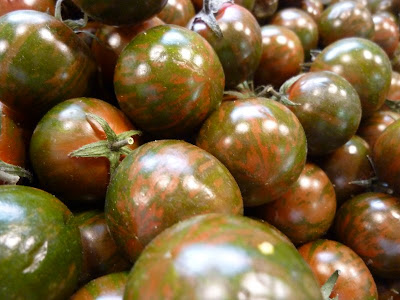
These tomatoes look almost black due to the blend of their dark green and red pigmentation; in the case of the Sun Black variety, due to the presence of anthocyanin pigments in the skin (also found in eggplants, blackberries, violets, cherries, red cabbage).


The pomodoro di riso (rice tomato) is used to stuff with rice and bake. The best pomodori di riso come from Fondi in Southern Lazio. They're large and have only a few large seed pockets, lending themselves well to stuffing with rice.


The pomodori Colonna look suspiciously like the San Marzano...


Cherry tomatoes (ciliegini) are great for salads and eating on their own...


Datterino tomatoes are similar to a cherry tomato, but smaller and slightly elongated...


The Ikram tomato is usually sold a grappolo, on stems as a bunch of tomatoes, usually five or six per bunch. They're a great all around tomato: for sauce, insalate caprese, salads.


These are only the tomatoes I saw today at the Ponte Milvio market, but they're by no means all that's available. Each time I go to the market I see other varieties.
My garden is filled with many kinds of tomatoes; right now there are hundreds of datterini growing. They're so sweet and tasty that for every few I pick I pop one in my mouth. Today I made a tomato sauce with datterini for lunch and last night I made pasta caprese, the quintessential, super easy, summer pasta dish:

Penne Caprese (serves 5 to 6 people)

Ingredients:
  • 1 garlic clove, finely chopped
  • Olive oil, 1/2 cup
  • Buffalo mozzarela, two large, cubed
  • Medium tomatoes, about six, seeded & cut in bite sized pieces, or 30 datterino tomatoes.
  • Basil leaves, about 20
  • Salt to taste, about 1 tsp.
  • Penne pasta, 500 grams
Procedure:
  • Marinate the garlic in the olive oil, in the serving bowl.
  • Add the other remaining ingredients.
  • Cook pasta in boiling salted water until al dente.
  • Drain pasta, add to serving dish, toss and serve.