Wednesday, July 20, 2011

Topkapi - Turkish Restaurant in Rome


My friend Karen started the Lunch Bunch a few months ago to get friends together to try some of Rome's ethnic restaurants. Ethnic restaurants are not Rome's strong suit, but nonetheless it's nice to dine on something other than Italian fare, fabulous though it is.
Yesterday we had lunch at Topkapi (Via Nomentana 81, tel. 06 4429 2408, info@topkapi.it). Katie Parla briefly reviewed this restaurant back in 2010 when it was known as Antichi Sapori della Turchia. The Turkish Chef Hikmet Ozkaya was the chef at the Turkish Embassy in Rome prior to joining Topkapi.
The dolma (stuffed cabbage and grape leaves) were tasty:


I love Bakla Ezmesi (hummus made with fava beans) and although this dish photographed well it was disappointing. The flavor was bland, and as the dish had been plated hours before it was dried out.


By contrast, the fried calamari (Kalamar) was delicious. Chef Ozkaya's wife, who served us, convinced me to try it based on its Tarator sauce. The sauce was made with equal parts yogurt (homemade in the restaurant) and ground walnuts, chopped dill, garlic, cucumbers and salt. It sounded odd but the chef's wife was so convincing that I opted for it. When I tasted the sauce on its own I didn't like it at all.


The sauce with the calamari was fabulous; a case where the total is greater than the sum of its parts. The calamari were fresh, crisp, tender and cooked to perfection. This is the dish that will bring me back to Topkapi.


I also had a very tasty Barbunya pilaki: borlotti beans with garlic, carrot, tomato paste, olive oil and a touch of peperoncino.
We all shared a simple but tasty chicken and vegetable dish with a rice pilaf.


If you're curious about Turkish cuisine visit Wikipedia or Hayriye's Turksh Food and Recipes.

Sunday, July 10, 2011

"Tiella" from the Gulf of Gaeta, Southern Lazio


Sperlonga has been just about my favorite place on earth for well over twenty years. When Giulia was little we used to spend the month of June in a spartan, but charming beachfront apartment. Back then I was the only foreigner in Sperlonga, literally. Only the big hotels (and big still meant fairly small and family owned) had sdrai or lounge chairs, on the beach. No phone, no television and internet was unheard of. In a word, heaven. We bought all our food on a daily basis from local fish vendors, fruit & vegetable stands and a local alimentare, the same one I've been going to for twenty plus years.
On Friday my daughter and I, along with some visitors from London, decided to "escape" the heat by hopping a train down to Sperlonga. It was one of those hot, humid Italian days with no hint of a breeze. We rented sdrai and ombrelloni on the beach. These days there's not a square foot of beachfront area where you can throw down a towel and lay in the sand. In the end, I spent the entire day under the umbrella fantasizing about returning to the peace and quiet of my pool. But it was great fun all the same. The view of the hill town of Sperlonga alone made the excursion worth it. I never tire of that view. The water was clean and crisp and delightful: Sperlonga prides itself on having the top water cleanliness rating along the coast.
For me it always boils down to the food and Sperlonga offers plenty to satisfy. We kept it simple: a few gelati from the Pasticceria Fiorelli which, in addition to amazing ice cream, has the best doughnuts in Italy.
Then it was on to the same alimentare we've been going to for decades, still owned by Carmina and Sandro, still with the same ebullient sales girls working the banco gastronomico (deli counter). They are not girls, or even young women; they can't be if I've known them almost a quarter of a century. But they look it. They're so friendly and welcoming that I usually end up purchasing much more than I intended to.
We always buy plenty of mozzarella di bufala, made just hours before: warm and succulent and redolent of fresh buffalo milk. Our London guests ate theirs as soon as we left the shop, right out of the bag and dripping with milky flavor.
Carmina and Sandro's alimentare is always fully stocked with tielle. They're so good I usually buy a small slice of every kind. The tiella, typical to the Gulf of Gaeta, is something in between a pizza and a calzone. It's the shape of a pizza with a softer dough, and filled, like a calzone.
Like so many Laziale gastronomical specialties, the tiella was born a poor man's food and a way to use up leftovers. The local favorite is filled with calamari, tomato, olive oil, parsley and a touch of peperoncino (below right). The tiella alla parmigiana is filled with eggplant, cheese, tomato and fresh basil. Another popular filling is potatoes and zucchini (below left).


These tielle are all filled with assorted fresh vegetables cooked in local olive oil, cheese, prosciutto and mortadella.


Legend has it that Frederick IV of Bourbon, who ruled the Neapolitan Republic for a time during the 16th century, was so fascinated with the tiella that he came up with the idea to honor it by creating different types, each with different tasty fillings.
The name comes from the round teglia (hence tiella) or baking sheet used to bake tielle. A disc of dough is placed in the teglia, filling is placed on top and then a second disc of dough is placed over the filling.
The best recipes I've run across for the Tiella di Gaeta made with polipi and calamari are in Italian. It's such a simple dish that it should be fairly easy to follow, even in Italian:

Saporetipico.it
Mondodelgusto.it

Here is my simple recipe to prepare the dough, which you can also use for pizza:

Ingredients:
  • Flour, 1 kg
  • Yeast, one cake
  • 1 Tsp sugar
  • 2 Tbsp olive oil
  • 2 Tsp salt
  • 300 ml water, plus an additional 200 ml water as needed
Dough preparation:
  • Combine 300 ml of tepid water with the yeast and sugar. Gradually combine the yeast mixture & flour.
  • As needed, add the additional 200 ml water so that you have a soft, kneadable dough. Add the salt and 1 tbsp oil to the dough.
  • Knead the dough until it is smooth & elastic, about 5 minutes.
  • Put the remaining 1 tbsp of olive oil into a large bowl, and place the dough in the bowl, covering it with the oil.
  • Cover the bowl with a damp cloth and allow the dough to rise until doubled in bulk, about 45 minutes. Punch dough down & make into 6 to 10 dough balls.
  • Roll each ball into a disc, or rectangle, that will just fit into a wide-rimmed baking sheet.

Monday, July 4, 2011

The Tomato: Reigning Queen of the Market All Summer Long


It's difficult to think anything but pleasant thoughts while eating a homegrown tomato. ~Lewis Grizzard, American writer & humorist


My favorite Roman market is at Ponte Milvio. Tourist free, full of great produce but not so large that it's overwhelming. It used to be outdoors, running along the lungotevere, but like so many of Rome's larger markets it's been moved to an indoor space. Why? Many reasons probably, not the least of which was the traffic problem the market created. In the past this wouldn't have been an issue as people used to walk to and from the market to do their daily shopping. Anymore people head to the market in their car, leave it double or triple parked and quickly grab what they need from their banco di fiducia (preferred produce vendor), creating a parking and traffic nightmare.
In addition, what was left behind after market closing created a clean-up nightmare each day for the local Della Vittoria quartiere of Rome. To alleviate the clean-up problem, relieve traffic and offer parking to clients, indoor markets are popping up all over Rome to replace the larger outdoor markets. It's the end of an era, but I'm not at all unhappy to have a parking lot right under my favorite market.
More than a few days each week I'm at the market conducting market tours and picking up ingredients with clients for our cooking classes. Every week there's something a bit different available, but throughout the summer every banco has an abundance of wonderful tomatoes. It's true that the tomato's origin is in North America, but it was Italy that took this fruit and turned it into something marvelous.
One of my favorite tomatoes is the Cuore di Bue (Oxheart). This tomato is large (often weighing upwards of 200 grams) is very textured, with few seeds and almost pink. The skin is so tender there's never a need to peel them. They're great on their own or used to make dishes like Acqua Pazza.


The Casalino tomatoes on the left were grown in Sicily or are a Sicilian variety. Generally the Casalino tomato grows in the Southern Lazio region, from the hills of Itri to the seaside town of Gaeta. This tomato has a slightly acidic flavor and is at its best in early summer. In the past the Casalino was grown in between vigne (grape vines).


Frequently produce sold at the market will indicate its growing area, like the Sicilian Casalino tomato above.
These tomatoes were grown in Cerveteri, north of Rome.


The San Marzano tomato (a plum tomato) is one of the best known tomatoes, and the easiest to recognize, given its elongated oval shape and uniform size. Throughout Italy, and perhaps worldwide, San Marzano tomatoes are deemed to be the best tomatoes for sauce and canning. Originally the plant was grown in the San Marzano area of the Campania region, but is now grown worldwide.


These tomatoes look almost black due to the blend of their dark green and red pigmentation; in the case of the Sun Black variety, due to the presence of anthocyanin pigments in the skin (also found in eggplants, blackberries, violets, cherries, red cabbage).
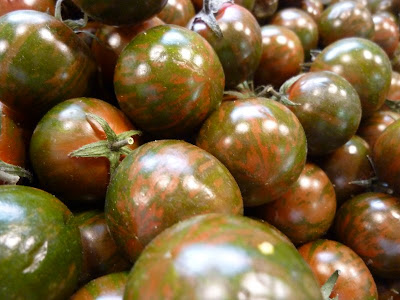


The pomodoro di riso (rice tomato) is used to stuff with rice and bake. The best pomodori di riso come from Fondi in Southern Lazio. They're large and have only a few large seed pockets, lending themselves well to stuffing with rice.


The pomodori Colonna look suspiciously like the San Marzano...


Cherry tomatoes (ciliegini) are great for salads and eating on their own...


Datterino tomatoes are similar to a cherry tomato, but smaller and slightly elongated...


The Ikram tomato is usually sold a grappolo, on stems as a bunch of tomatoes, usually five or six per bunch. They're a great all around tomato: for sauce, insalate caprese, salads.


These are only the tomatoes I saw today at the Ponte Milvio market, but they're by no means all that's available. Each time I go to the market I see other varieties.
My garden is filled with many kinds of tomatoes; right now there are hundreds of datterini growing. They're so sweet and tasty that for every few I pick I pop one in my mouth. Today I made a tomato sauce with datterini for lunch and last night I made pasta caprese, the quintessential, super easy, summer pasta dish:

Penne Caprese (serves 5 to 6 people)

Ingredients:
  • 1 garlic clove, finely chopped
  • Olive oil, 1/2 cup
  • Buffalo mozzarela, two large, cubed
  • Medium tomatoes, about six, seeded & cut in bite sized pieces, or 30 datterino tomatoes.
  • Basil leaves, about 20
  • Salt to taste, about 1 tsp.
  • Penne pasta, 500 grams
Procedure:
  • Marinate the garlic in the olive oil, in the serving bowl.
  • Add the other remaining ingredients.
  • Cook pasta in boiling salted water until al dente.
  • Drain pasta, add to serving dish, toss and serve.

Wednesday, June 29, 2011

Culinary Tips & Tools: Tegole (Roof Tiles) for a Serving Platter


I never seem to have enough serving dishes and platters when I have a big group to contend with. Bringing out the silver isn't always the right way to go (fortunately, as I'm short on silver anyhow!). Besides, given our location, country chic is much more appropriate, especially in the summer months. So I always look around for something I already have at home to cleverly adapt into a serving platter, but generally nothing jumps out at me. So I usually resort to ceramic serving dishes and platters. Don't get me wrong, I love them! They're all hand-painted from different places in Italy. Some I've had made, some purchased, some are antique and quite valuable. Still, a little variety is nice.
The other week we attended an event at the American Academy, home to the Rome Sustainable Food Project. For those who don't know, it's a joint endeavor dining program for the Academy residents, between the American Academy and Alice Waters, the mother of culinary sustainability.
The food is simple, but delicious fare: all grown in the Academy's edible garden or sourced locally from organic producers and then transformed into masterpieces by Chef Mona Talbott and her chef assistants and interns. Our cocktail was served on the Academy grounds, next to the edible garden. A simple but tasty appetizer: almonds and cherry tomatoes. What charmed me was the serving platter: antique Italian tegole (roof tiles), covered with a fig leafs. It was in keeping with the theme and style of the event, and the sustainable philosophy of the Rome Sustainable Food program.
Our dinner of roast lamb and vegetables was also served on the tegole. Lighting was poor (an insufficient number of candles placed on the tables) so I was unable to see the food well, let alone photograph it. Food is multi-sensorial and I like to be able to see what I'm eating... it's a large part of the pleasure.


The tegole I have are not antique, but I think they'll lend themselves admirably to my next terrace dinner or cocktail event. I plan to use the tegole to serve fruit & breakfast for our B&B guests. And why not use some other household terra cotta pieces while I'm at it?

If you're looking for some appetizer serving ideas, check out myrecipes.com or about.com.

Sunday, June 26, 2011

Scoop of the Week: Banana Ice Cream


I've always loved bananas and eat one or more a day. They go against my goal to always eat sustainably and locally, but it's one of the exceptions I make. If bananas were ever in season in Italy I'd wait patiently, but they aren't. So I eat them a lot, all year round.
Lately I've been trying to make ice creams that recall something sweet and delicious that I love. Banana bread is one of these things, but it's only recently, thanks to Cook's Illustrated, that I now make a perfect banana bread.
My approach to ice cream (in this case banana) is to look at the ingredients in banana bread and try to use them in my ice cream. Bananas have to be over-ripe to achieve a rich banana flavor, but Cook's Illustrated takes this one step further. They suggest microwaving the bananas for five minutes and then using a fine mesh strainer to separate out the banana juice. The banana juice is then cooked until it is reduced by half and added back to the bananas. What you achieve is a deeper, richer banana flavor and a banana bread that is much lighter. I used this same approach in my ice cream and it worked divinely.

Ingredients:
  • Over-ripe bananas (black and soft), peeled and mashed - 2 1/2 cups, about 6 bananas (600 grams)
  • Cream, 1/2 liter
  • Sugar, 1/2 cup ( 100 grams)
  • Eggs, two whole
  • Toasted pine nuts, 1 cup (125 grams) - optional
  • Dark rum, 1/8 cup (30 ml) - optional
Procedure:
  • Use a potato masher to mash the bananas. Don't process the bananas: you want to have some bits of banana in the ice cream.
  • Whisk the sugar, cream and egg together in a saucepan.
  • Cook over medium heat, stirring constantly, until the mixture thickens enough to coat a wooden spoon.
  • Place the pan, lidded, in an ice bath and cool thoroughly, stirring occasionally.


  • Cook the mashed bananas in the microwave on high for 5 minutes.
  • Strain the bananas for about 30 minutes over a fine mesh strainer.


  • The banana juice, once cool, has a gelatinous appearance. Cook it in a saucepan until reduced by half.


  • Whisk the cream mixture, banana pulp, banana juice and rum together until well amalgamated.
  • Place the mixture in the freezer.
  • Every half hour whisk, or stir, the mixture vigorously until frozen solid to avoid the formation of ice crystals.
  • Place the pine nuts in a frying pan and toss gently until just golden. Cool.
  • Once the ice cream is almost frozen solid stir in the pine nuts.
I made the ice cream in four different ways: without pine nuts and rum, with pine nuts only, with rum only and with pine nuts and rum. It was great all four ways. This ice cream is so tasty, and the texture of the bananas so luscious, that I think I like it best just with bananas.


If you are allergic to dairy or eggs try this recipe using only bananas.
David Lebovitz uses brown sugar and coconut milk in his version of banana ice cream.

Saturday, June 25, 2011

Edible Lazio: Sagre this week-end


I spent the morning, as I always do on Saturdays, with my husband. Enjoying a coffee and cornetto, reading the paper, driving around to different towns in northern Lazio to run errands...and just for the pleasure of it. Fiano Romano, pictured above, is one of my favorites.
I also spent a bit of time tweeting about the different sagre (food fests) going on in the fabulous Lazio region this weekend.
The tomato is the star of most sagre as in one way or another it usually appears in the signature dishes each town is showcasing over the weekend.


The essential element of the sagra is that it features the town's tastiest, locally produced, in season food or beverage. In other words it's all about sustainability. Many of these sagre have been going on for decades and are a time for the town to celebrate with music and dancing and other activities. The main event, however, is the food and everyone gathers in the town square to enjoy a feast.
I love snails, both the sea and field variety, and happily a few sagre feature them this weekend.
  • Monte Rotondo's Ciummacata (field snails) will be prepared with tomato sauce and peperoncino.
  • Valmontone is celebrating its 31st field snail sagra.


Some of the other sagre happening in the Lazio region this weekend:
  • Rocca Priora is hosting its first ever clam sagra, and will also prepare fried moscardini.
  • Sipicciano's 6th sagra features something sweet: the bombolone casareccio, fried and filled with cream, jam, nutella and white chocolate.
  • On this hot weekend head to the hill town of Montelibretti for the town's wine fest featuring wines from local grotte antiche (antique wine caves).
  • Nerola offers up pappardelle al ragu' di cinghiale (wild boar sauce) as part of their sagra of homemade pasta and game.
  • Faleria hosts its second summer tartufo fest today and tomorrow.
  • Valcanneto's arrosticino (skewered lamb) sagra will also be its second ever.
  • Pizze fritte for the 28th sagra della frittella in the Laziale town, Terrignano, today and tomorrow.
  • Ardea will feature spaghetti cacio e pepe, served at the town's Sforza castle.
  • Lazio's abundant sagre are not just ebible fests: check out the infiorata artistica (flower display) in charming Poggio Moiano.
If you'd like to keep up to date on the various sagre going on throughout the year in Lazio there are a few websites you can look at: http://www.sagreinitalia.it/sagre-in-lazio.asp or http://www.laziofeste.it/

Sunday, June 12, 2011

Scoop of the week: Cherry Ice Cream


When I was little we used to spend part of the summer at our grandparents' home in Downers Grove, outside of Chicago. I haven't been back since, but at the time Downers Grove was a small suburban location, almost rural.
Two of my strongest memories from those visits pertained to food. Pepperidge Farm was located in Downers Grove and I used to love walking by their baking facility; the aroma of baking bread was almost tangible. The other memory was cherries. My grandmother used to can cherries from her trees and her pantry was laden with quart-sized jars of cherries. I can't recall what my grandmother looked like, or anything about her, but I do remember the shelves of canned cherries. They were delicious eaten right out of the jar and to this day I don't think there's anything tastier than a cherry pie made with fresh cherries.
Cherry season in Rome doesn't last long, just a month or so from mid-May to the end of June. It's unbearable that cherries are available for such a short time period, but it makes them all the more desirable when they are in season. I plan to bake a cherry pie this week, but today I opted for cherry ice cream. We're doing an 80th birthday dinner for one of our clients and her family, and I've baked her a luscious chocolate birthday cake for the event. Cherries and chocolate are a natural together, so cherry ice cream seemed a grand idea on this hot June day.
My ice cream is in the freezer now and every half an hour or so I give it a good stir with a wooden spoon. It should be frozen solid by dinner time.

Here's the recipe:

Ingredients:
  • Cherries, pitted - 525 grams (3 cups)
  • Sugar - 65 grams ( (1/4 cup)
  • Cream - 410 ml (1 3/4 cups)
  • Milk - 180 ml (3/4 cup)
  • Egg yolks - 2
  • Sugar - 65 grams (1/4 cup)
  • Salt - a pinch
  • Cherry syrup - 30 ml (2 tbsp)

Procedure:
  • Pit the cherries using a cherry (olive) pitter, like the one below.
  • Toss the cherries in the sugar and set aside.


  • Cream the egg yolks and sugar together until the yolks are a pale yellow.


  • Put the cream, milk and cherries in a blender and process until the cherries are roughly chopped.
  • Cook the cream, milk and cherry mixture several minutes on medium until warm.
  • Add the salt, egg yolks and sugar and cook several minutes over low heat until the mixture coats a wooden spoon.
  • Stir in the cherry syrup.
  • Place the pan in a sink full of ice water and stir occasionally until cool.
  • Put the pan in the freezer and stir every 30 minutes until frozen solid.
You might want to try the Simply Recipes version of cherry ice cream with chocolate chips.
Another cherry ice cream recipe you might want to take a look at: Canadian Living