Friday, April 29, 2011

Pea Soup topped with Crunchy Guanciale


I love pea soup in the winter, and in the spring when peas are fresh and in season, and what really makes it tasty is the addition of crunchy guanciale on the top.
So what exactly is guanciale and what differentiates it from pancetta? Guanciale is pork jowl or cheek: guancia is the Italian word for cheek, hence guanciale. Pancetta comes from the abdomen or belly area. Pancia is the Italian word for abdomen, hence pancetta.
Guanciale is almost all fat, whereas pancetta is a much meatier pork product. You can really see the difference in this picture as our local grocer holds up both (guanciale on the left):


Guanciale is traditionally used to prepare some of the best Italian pasta sauces: pasta alla carbonara and pasta all'amatriciana. Both are local Roman, poor man's dishes. The ingredients are simple but many restaurants don't quite manage to cook the guanciale correctly. Unfortunate as it's the magic ingredient in both of these dishes. The key is to cook the cubed or sliced guanciale slowly, over low heat until it's golden and crisp.


Cubed and just in the frying pan the guanciale looks like this:


Much of the fat has begun to melt and the guanciale is beginning to brown...


Once the cubes are nice and golden brown prop the frying pan up slightly to drain the excess fat from the guanciale cubes.


Pea Soup:

Whether you're using fresh peas from the garden or dried, split peas in the winter the procedure is the same; only the cooking time varies.

Ingredients:
Two cups shelled fresh peas (or dried split peas)
One medium onion, minced
2 tbsp. olive oil
2 tsp. salt
Water, 2 to 4 cups

Preparation:
Sauté the onion in the olive oil until translucent.
Add the peas, several cups water and salt and simmer until the peas are tender. Add more water as desired.
Allow the soup to cool, then place in a blender & process until smooth and creamy.
Reheat the soup and serve in bowls topped with cubed guanciale.

Tuesday, April 26, 2011

Reflections on our sustainable Easter


Easter started off with a breakfast of succulent Tarocco oranges from Sicily.
We bought pizza bianca from our neighboring town of Castelnuovo di Porto and, although I've not sampled pizza bianca from every bakery, I am pretty sure this is the best.


We served our guests two sheep cheeses to eat with the pizza bianca, one of which was fresh ricotta di pecora, made just hours before.


This morning I used fresh eggs from our neighbor's chickens to make omelettes and French toast, using Colomba Easter bread. Our neighbors chickens are all free range and spend their days enjoying the countryside almost as much as we do.


Lunch was at our neighbor's country farm. Everything was prepared fresh using produce and animals from the farm. The two authors of our fabulous meal are the matriarchs of the family, women who have just passed the eighty year mark and live guided by a lifestyle that is slowly disappearing.
Lina, who I've known for two decades now, moves at a slow & efficient pace. I've never seen her rush to do anything and yet I don't know anyone who accomplishes more in a day than she. She chops the wood for their fireplace, raises the animals and tends to the produce that graced our Easter table.
When I think of sustainability and how it should be I think of Lina. She cares for her animals with affection and humanity and when the time comes to slaughter them does so using that same affection and humanity. She really is the benchmark that we all want to strive for. And yet the reality of "farm to table" in its truest sense is just a little bit difficult for me. Lina's two daughters are both professionals and while they enjoy the fruits of Lina's labors neither has the heart to take the life of an animal when the time comes. They've offered to raise the rabbits and chickens if I then slaughter them but so far I just can't make that jump. When Lina is gone, with her will go the generation of small farm traditions now present all over the Roman countryside.
Lina and Alfredo's garden is almost enough to feed their extended family year round. Today we had Roman-style artichokes and roast potatoes, both cooked with olive oil from their olive trees and herbs from the garden.


No meal is complete without freshly baked bread, this from the local town bakery in Riano.


Roast baby spring lamb is the Easter tradition and now the hills are covered with sheep and their baby lambs grazing the hillsides.
These lambs were crossing the street in front of my car the other day. Lina and Alfredo don't have sheep, but most farmers in the area do.


One of Lina's best dishes is coniglio (rabbit) alla cacciatore. Lina makes it with fresh herbs, olive oil, garden tomatoes and olives preserved from last fall's olive picking. It's simply delicious.
Lina raises rabbits year round. They have a large, pristinely clean living space and feed on hay and leftover vegetables.


And on to dessert! We are now right in the midst of strawberry season: we had a huge bowl of berries with fresh cream and sugar.


In addition to the traditional Colomba Easter bread we had Pastiera Napoletana and an upside down pear tart.


Roman tradition has it that on May 1st everyone has a country lunch of pecorino Romano cheese and fava beans fresh from the pod. As Easter was so late this year the fava beans were already ripe for the picking. Mid-afternoon, after coffee, we picked fava beans from Alfredo's vegetable garden and ate them in the garden.

Saturday, April 23, 2011

Homemade Pasta....a picture says a thousand words


On our way home this morning we stopped to visit some neighbors and before we left they gave us a precious gift; five freshly laid eggs. So I decided to use two of them to make fettuccine for our lunch.


The recipe for pasta is simple: 100 grams of flour + 1 egg = 1 portion of pasta. Pasta recipes tell you to mix the egg into the flour, knead until smooth & elastic, roll out into a sfoglia or sheet and then cut into the desired shape. Basically very simple, and indeed it is once you have the "feel" for it.
I'm always being asked in cooking classes how the pasta should "look" and how it should "feel", so herein lies a detailed pictoral explanation of both.

After you make a well in the flour, crack your eggs into the center of the well.


Whisking with a fork, gradually incorporate the flour into the eggs.


Gradually the flour will be absorbed into the flour. Keep using the fork to mix; it's still way too wet to knead.


When the flour and eggs look like this it's time to begin using your hands. Make sure you flour your hands first...


Pasta dough is not delicate so don't worry about roughing it around a bit. Knead whatever way works best for you: squeeze it, or fold over & press with the heel of your hand. Keep kneading until the egg and flour get fully amalgamated, about five minutes total.
As you get started it will look like this:


Here is what your finished product should look like. It's a smooth & elastic, fully incorporated ball of dough. All the flour from the work surface has been absorbed into the dough.


Now you pass onto the next kneading phase: within the pasta machine.
You don't have to use a pasta machine by any means; the whole process can be done with a rolling pin (use a 1 1/2 foot long dowel about two inches thick).
I use a manual pasta machine. They are readily available just about anywhere, but make sure you purchase a quality Italian machine.
Smash down your ball of dough so that it's thin enough to pass through the widest setting of the pasta machine. Roll it through repeatedly (about ten to twenty times), folding in half before you pass the dough through each successive time.
At first the dough will look like this:
It's uneven and has a porous look to it...


Here, it's smoothed out a lot, but still has a porous appearance and the edges are uneven. It doesn't yet have a smooth & elastic feel to it.


Getting much smoother, yet the dough still has a slightly lumpy un-smooth look to it...


Much smoother, almost where you want it to be....


And now, finally, you are rolling through a smooth, elastic sheet:


At this point begin passing the dough through the pasta machine at successively smaller settings. For filled pasta (ravioli, tortellini) roll the dough through until you reach the smallest setting. For unfilled pasta (spaghetti, fettuccine) you're best off using the next to the last setting as your final thickness.
Here is the final product: it's smooth, has no bumps, no porousness whatsoever and the edges are also smooth and even.


Next, cut the pasta into the desired shape. I made fettuccine today. Once I cut the pasta into fettuccine I lightly dusted them in flour.


Then place the fettuccine on a floured dishtowel, twirled into little round mounds to dry. Don't pile too much together; just a bit per mound otherwise the pasta won't dry and will begin to stick together.


I made the fettuccine today for immediate consumption, therefore as I was finishing up the pasta I was also boiling some water.
Salt the water with a handful or two of rock salt. Be sure to boil a large enough pan of water so that when you add the pasta to the water it can immediately return to boiling temperature.
Super fresh pasta only needs two to three minutes cooking, and it should be al dente. When the pasta is done it has a certain look to it: it becomes a paler yellow, almost creamy looking. If you compare the pasta in the boiling water below to the picture above you can see the difference in color.


Drain the pasta gently in a colander; remember: it's fresh and therefore delicate. Toss with a pasta sauce of your choice. I used a simple tomato sauce made with fresh tomatoes, olive oil, garlic & salt. As the sauce was cooking I made, and then cooked, the pasta. The entire process for everything took twenty minutes....and worth every minute for the resulting delicate, fresh flavor of both pasta & sauce!

Friday, April 22, 2011

Easter Tradition: Chocolate Eggs and Colomba

The Viani Bar in Morlupo, just north of Rome, not only has wonderful breakfast pastries, great sandwiches and home-made ice cream. It also prides itself on always having fabulous decorations and edible gifts for every holiday. I had lunch there today and was mesmerized by the gorgeous Easter eggs and Colomba (traditional Italian Easter cake) they had on display.

The Easter eggs are wrapped in colorful metallic wrapping paper. Each egg is filled with a surprise, usually a small toy, key chain or piece of jewelry. Some of the more expensive Easter eggs on sale contain more elaborate gifts.


The nicest packages by far on sale at Viani are the Colomba. The traditional Easter Colomba, like the one below (the Colomba "classica") is a sweet yeast bread filled with candied orange and topped with whole almonds and sugar. It's beautifully packaged in a box covered with artificial flowers so pretty that they almost seem real.

The pasticceria that produces this Colomba, and distributes throughout Italy, is Flamigni Pasticceria. The company is located in Forli' in the Emilia Romagna region and has been owned and operated by the three Flamigni brothers since 1930.


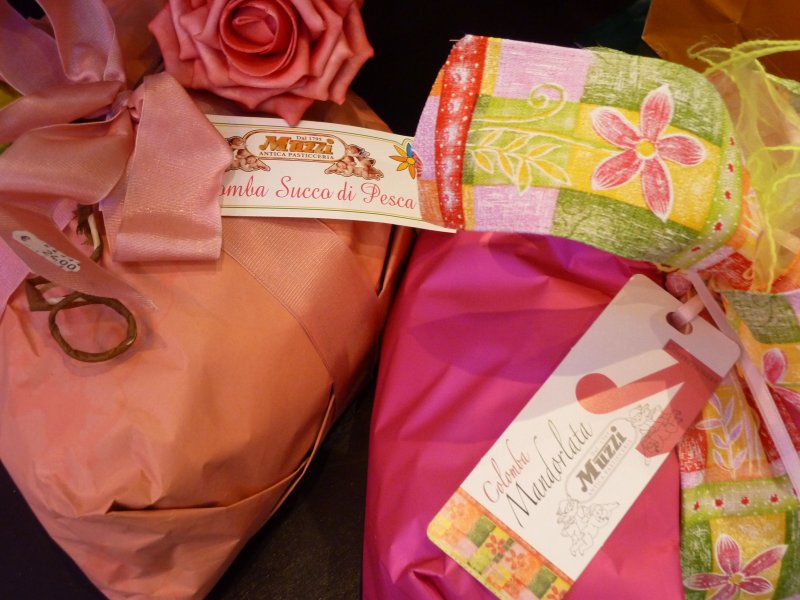
Another Colomba producer is Pasticceria Muzzi, located in Foligno. Muzzi is a much older company than Flamigni and dates back to the late 1700's.
These two beautifully packaged Colomba vary from the standard recipe: one is peach flavored and the other is filled with almonds.


This Colomba, again featuring a beautiful artificial flower on a violet package with pink & green ribbon, is made with wild berries. The price for the Colomba is about four times what you would pay for a standard Colomba in an alimentari or grocery store. The price is for the lovely and unique packaging, but if you want to give someone a Colomba as a gift these are exquisite.


My favorite is this ladybug package. I love the red and white polka dot paper, the wooden ladybug attached to the package, complemented by red and white flowers.


I also like this Colomba in it's pretty orange and brown basket with orange ribbon and decorated with artificial oranges.


Almost every pasticceria in Italy produces Colomba at Easter-time and most have beautifully packaging. So if you will be an Easter lunch guest in an Italian home this is the perfect gift to bring!

Wednesday, April 20, 2011

Italian "Colomba" Easter Cake French Toast


I can't say that the traditional Italian Colomba Easter cake strikes much of a chord with me although Italians go crazy for it. I've come to enjoy the Colomba, but only because I now think of it as more of a sweet bread than a cake.

There is, however, one way to serve Colomba that is exquisite: as French toast. It's incredibly moist and as the bread is sweet to begin with it barely even needs butter and syrup. The Colomba is filled with candied bits of orange and coated with whole almonds and sugar which adds to the flavor. I slice it into one inch slices as otherwise the slices fall apart when dipped into the egg mixture.


Prepare a mixture of a few eggs and a cup or more of milk, according to taste, and whisk until well blended. Lightly oil a pan with extra virgin olive oil, and once the pan is hot dip the bread slices into the egg mixture and pan fry on both sides until golden brown.


Place the slices on a platter and serve as is or lightly dusted with powdered sugar.


All the same, I can never resist adding melted butter and maple syrup or honey for an extra special Easter breakfast treat!